NATURAL FARMING
Growing food by trusting nature
Natural farming means working with nature instead of controlling it. Instead of forcing the land, we observe, wait, and let plants and soil life do most of the work.
It rebuilds the soil, it brings back life, and it makes us a little more self-reliant. And it changes you too: you learn to let go of control and to follow the rhythm of the land.
THE PRINCIPLES
Five things we don't do
We follow the ideas of Masanobu Fukuoka, the Japanese farmer who spent his life showing that the less you interfere, the more nature gives back.
No Ploughing
Turning the soil destroys its structure and the life in it. We leave it as it is.
No fertilising
Green manure and plants feed the soil, instead of bags of fertiliser.
No weeding
Other plants and a layer of mulch keep the soil covered and protected.
No pesticides
A living, varied garden finds its own balance.
No pruning
New trees are allowed to grow into their natural shape.
WHY IT MATTERS HERE
Dry land on the edge of desertification
Our climate has very cold winters, hot dry summers and only short rainy periods. The soil on our land was depleted. In a place like this, ploughing and bare ground only make things worse.
Natural farming does the opposite: it keeps the soil covered, feeds it and brings life back. Step by step, it can help stop desertification, and even reverse it.

ON OUR LAND
From a 600m2 garden to 4,5 hectares
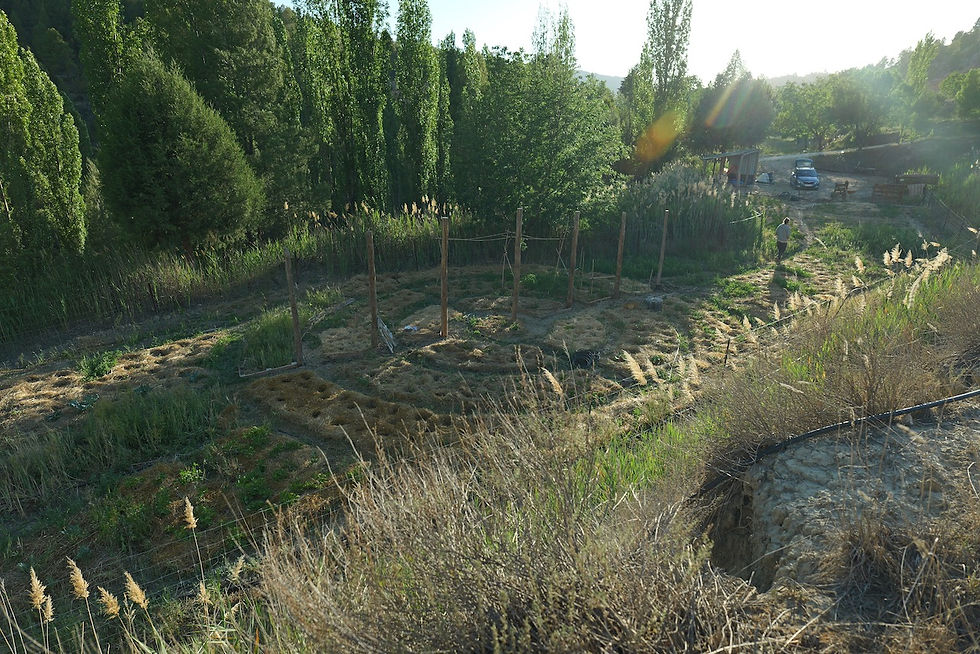
We started with a vegetable garden of 600 m². Next is the 4,5 hectares with water, which we want to turn into a communal garden that feeds people in the area. This is how we work on it:

Green manure twice a year
Oats, barley, peas, mustard, yeros and more. Because of our cold winters and dry summers we sow in autumn (September, October) and again in spring (March, April).

A thick layer of mulch
Mulch keeps the soil covered, cool and moist, and holds on to the little rain we get.

Seed balls
Seeds of grains, alfalfa, grasses and clover rolled in clay. We made them with our neighbours, using a cement mixer, and sow them in autumn.
OUR VEGETABLE GARDEN
A year in the garden
From bare ground to our first harvests: the 600 m² garden, season by season. Next spring we start with the big 1200m2 garden on the new land!


TRIAL AND ERROR
What went wrong and what we learned
Natural farming invites you to let go: of expectations, of convictions, of all the beliefs about how things should be done that circulate around you. Again and again, it invites you to fall back into the arms of nature, to surrender and to trust her strength, while staying attentive and adjusting where needed. Things rarely go the way we planned. These are some of the moments that taught us the most.
The rain didn't come
We sowed green manure on the 4,5 hectares when rain was forecast. Then it hardly rained.
What we learned: Spread your sowing, and use seed balls when rain is uncertain for the next few days.
Hail
A hailstorm and heavy rain hit the young trees and the garden.
What we learned: It’s OK to protect your garden when circumstances ask for it, just as it’s OK to put a fence or protection around young trees.
Water comes first
Before any water reached the land and the new trees, the old irrigation channels had to be cleared by hand.
What we learned: Even though a NF garden no longer needs watering after a few years, extreme climates ask for other measures. If we don’t irrigate here, everything dies.
Self-sown
Part of the garden went its own way: plants came up where we never sowed them.
What we learned: Nature surprises you, especially when you don’t expect it. Give your garden space, and let plants grow where they want to.

WATCH
See it in practice


Questions people ask
Do you water?
Yes. The 4,5 hectares have irrigation rights, and the garden and young trees get water when they need it. Keeping the soil covered with straw helps us use much less.
What about weeds?
We don't pull them out. A thick layer of straw and green manure keep the soil covered, and the plants keep each other in balance.
Do you really never use fertilisers?
Only in the first years, we use well-aged manure. Our soil was so out of balance that it needed help to wake up. We use less of it every year, and after four to five years, when the soil is full of life again, it isn't needed anymore.
Isn't it slow?
At the start, yes. Depleted soil needs time to come back to life. First everything becomes greener, you will see more life in the soil. And after a few years, your yields will grow to. But don't expect too much in the beginning. Remember: you are restoring the soil, which is a long term vision, not a short term profit expectation.
Does it work in another climate?
Yes. The principles stay the same, only the timing changes. In a milder climate, for example, you can sow all your green manure in autumn.
Where do I start?
Start small: a few square metres, covered with straw, and green manure. Our free sowing calendar and the online course on starting a natural food garden help you on your way.